
MiYOSMART iQ: HOYA's New Myopia Control Lens for Children, Backed by the Latest Research


Is your child squinting at the TV, sitting closer to screens, or getting a stronger prescription every time they need new glasses?
Myopia in children is a global public health issue. Experts say myopia raises the risk of retinal disease, and this risk grows exponentially, with no level considered safe. That is why early care matters so much.
GALAXY BY OPTOMETRIST introduces MiYOSMART iQ, HOYA's newest myopia control lens, developed from the original MiYOSMART, which is backed by more than 100 research papers.
The 30-second summary ✔ A spectacle lens that corrects myopia and helps slow its progression in children at the same time ✔ 12-month study: 9 out of 10 children showed no clinically significant myopia progression ✔ Suitable from age 4, available in clear and light-adaptive versions
What Is MiYOSMART iQ Myopia Control Lens?
MiYOSMART iQ is a spectacle lens for children that corrects myopia for clear vision and helps slow myopia progression at the same time, using HOYA's D.I.M.S. (Defocus Incorporated Multiple Segments) technology, now upgraded to the Triple Enhanced Design (DIMS TED)
How it works: the centre of the lens is a clear zone for sharp vision, while the surrounding area has many tiny lenslets that send a "defocus" signal to the retina. This signal helps slow the elongation of the eyeball, the main cause of increasing myopia.

3 New Improvements in the Triple Enhanced Design
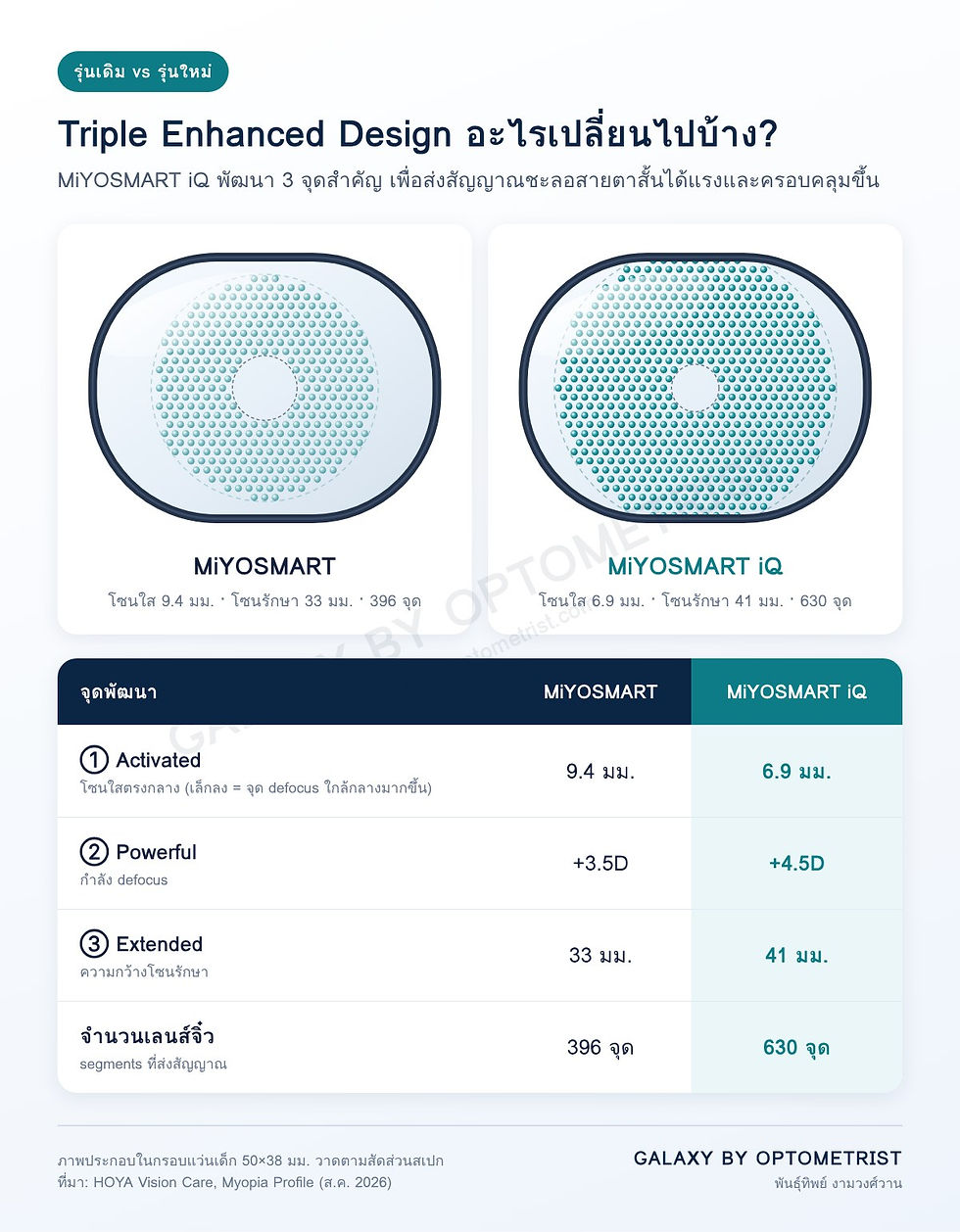
Activated – continuous, targeted action: The defocus segments sit closer to the lens centre (clear zone reduced from 9.4 to 6.9 mm) to continuously stimulate the near-peripheral retina, the area research shows responds best to myopia control signals. HOYA calls this the "Smart Zone".
Powerful – a stronger signal: Defocus power increased from +3.5D to +4.5D, sending a clearer signal to slow eyeball elongation.
Extended – wider coverage: The treatment zone widens from 33 to 41 mm and lenslets increase from 396 to 630, covering the child's field of view even in larger frames.
12-Month Clinical Study Results
HOYA partnered with The Hong Kong Polytechnic University on a randomized controlled trial in about 200 myopic children aged 4–12, presenting the results at ARVO 2026 in the United States and comparing 3 types of lenses.

Key Findings
9 out of 10 children showed no clinically significant myopia progression in the first year (change of less than 0.50D)
On average, myopia did not increase at all over 12 months (+0.05D vs -0.53D with standard lenses)
Eyeball elongation slowed by 77% compared with standard single-vision lenses (the original MiYOSMART achieved 40%)
About 4 in 5 children (82%) had eyeball growth similar to children without myopia, compared with 22% in the standard lens group
A First! Results in Young Children Aged 4–6
This is the first time a D.I.M.S. lens has shown myopia control in children as young as 4. In this study, MiYOSMART iQ was the only lens with a significant effect in the 4–6 age group, with average myopia progression of only -0.22D vs -0.64D with standard lenses, slowing refractive progression by 65% and slowing eyeball elongation by 44%
This matters a lot, because children who become myopic at a young age tend to progress quickly and face the highest long-term risk.
Children Aged 7–12
In this group, the average prescription stayed stable (+0.16D vs -0.51D with standard lenses) and eyeball elongation slowed by as much as 94%
Effect on the Choroid
Another study found that the choroid (the vascular layer beneath the retina) thickened within 1 week of starting MiYOSMART iQ and stayed thicker at 6 and 12 months, a biological sign that supports the myopia control mechanism.
Note: Individual results may vary depending on each child's eye health, age and visual habits. The data above comes from a 12-month study, and more long-term data is still needed.
Clear Vision, Comfortable Wear, Easy to Adapt
Some parents worry that a stronger signal might make vision less clear. The study found:
Overall vision was similar to standard spectacle lenses; central visual field showed no significant difference
Clarity at the lens periphery was reduced only very slightly and is unlikely to affect daily life
Children of all ages accepted, adapted to and wore the lenses all day
Sharp vision across the whole lens with an aspheric back surface and FreeForm technology
Up to 10% thinner than standard lenses, fitting a wide range of frames and looking better
Looks just like a regular spectacle lens
2 Options to Suit Every Lifestyle
MiYOSMART iQ Clear – clear lenses that look like regular spectacle lenses
MiYOSMART iQ Chameleon – light-adaptive lenses for children who spend time both indoors and outdoors, with the same myopia control performance
S.P.A.R.K. Coating – Tough Enough for Active Kids
Kids often put glasses down lens-first, drop them or wipe the lenses with their shirts. That is why HOYA developed the S.P.A.R.K. coating specifically for MiYOSMART iQ.

S – Scratch Resistant
Scratch resistance 50% higher than the previous generation, protecting the lenses from frequent handling, being placed on desks or packed into school bags
P – Protection
Repels fingerprints and dust, 5 times better water repellency than before, and 100% UV protection from the front of the lens
A – Advanced Technologies
High light transmission with reduced reflections and glare, for comfortable vision while studying, reading and using screens
R.K. – Ready for Kids
Designed for children's everyday lifeStill easy to clean even after almost 3 years of daily wiping
💡 Optometrist's tip: Rinse the lenses with clean water first, then wipe with a microfiber cloth, and always place the glasses lenses-up or keep them in their case. The lenses will stay in good condition for a long time.
Who Is MiYOSMART iQ For?
Children whose myopia keeps progressing, from age 4 and up
Children who became myopic at a young age
Children who have tried other myopia control methods without enough success
Every child must be assessed by an optometrist for suitability first.
How We Care for Your Child at GALAXY BY OPTOMETRIST
Assessment: a thorough eye exam by an optometrist
Precise measurement and fitting: the lenses must be centred exactly on the child's eyes for the best results
Follow-up every 6 months: to track changes in vision and adjust the care plan
Extra Tips to Help Slow Myopia

Wear glasses consistently all day
Spend more time outdoors
Follow the 20-20-20 rule: every 20 minutes, look 20 feet away for 20 seconds
Have regular eye exams
Frequently Asked Questions from Parents
How is MiYOSMART iQ different from the original MiYOSMART?
iQ places the defocus segments closer to the lens centre, uses stronger defocus power and has a wider treatment zone. In the 12-month study, iQ slowed eyeball elongation by 77%, compared with 40% for the original.
From what age can children wear it?
It is suitable for children with progressing myopia from age 4 and up, after an optometrist has assessed suitability.
How many hours a day should it be worn?
It should be worn all day like regular glasses. The more consistently it is worn, the more continuously the lens can send its myopia control signal.
Will it definitely stop myopia?
No method can guarantee 100% results. The lens helps slow myopia progression, and results vary by child, which is why follow-up every 6 months is needed.
Does it take long to adapt to the lenses?
In the study, children of all ages accepted and adapted to the lenses and wore them all day without affecting their everyday vision.
Book an Eye Exam for Your Child with an Optometrist
If you're concerned about your child's myopia, visit our optometrists at GALAXY BY OPTOMETRIST, Pantip Ngamwongwan, Nonthaburi
📍 Pantip Ngamwongwan, 2nd Floor, Central Zone, Ngamwongwan Rd., Bang Khen, Mueang Nonthaburi, Nonthaburi
📞 065-259-4141
💬 LINE: https://lin.ee/uMnfzfb
🕐 Open daily 10:00–19:00
Sources: HOYA Vision Care (hoyavision.com), Optometry Today – AOP (aop.org.uk, 7 May 2026), Myopia Profile (myopiaprofile.com, 31 Aug 2026)


Comments